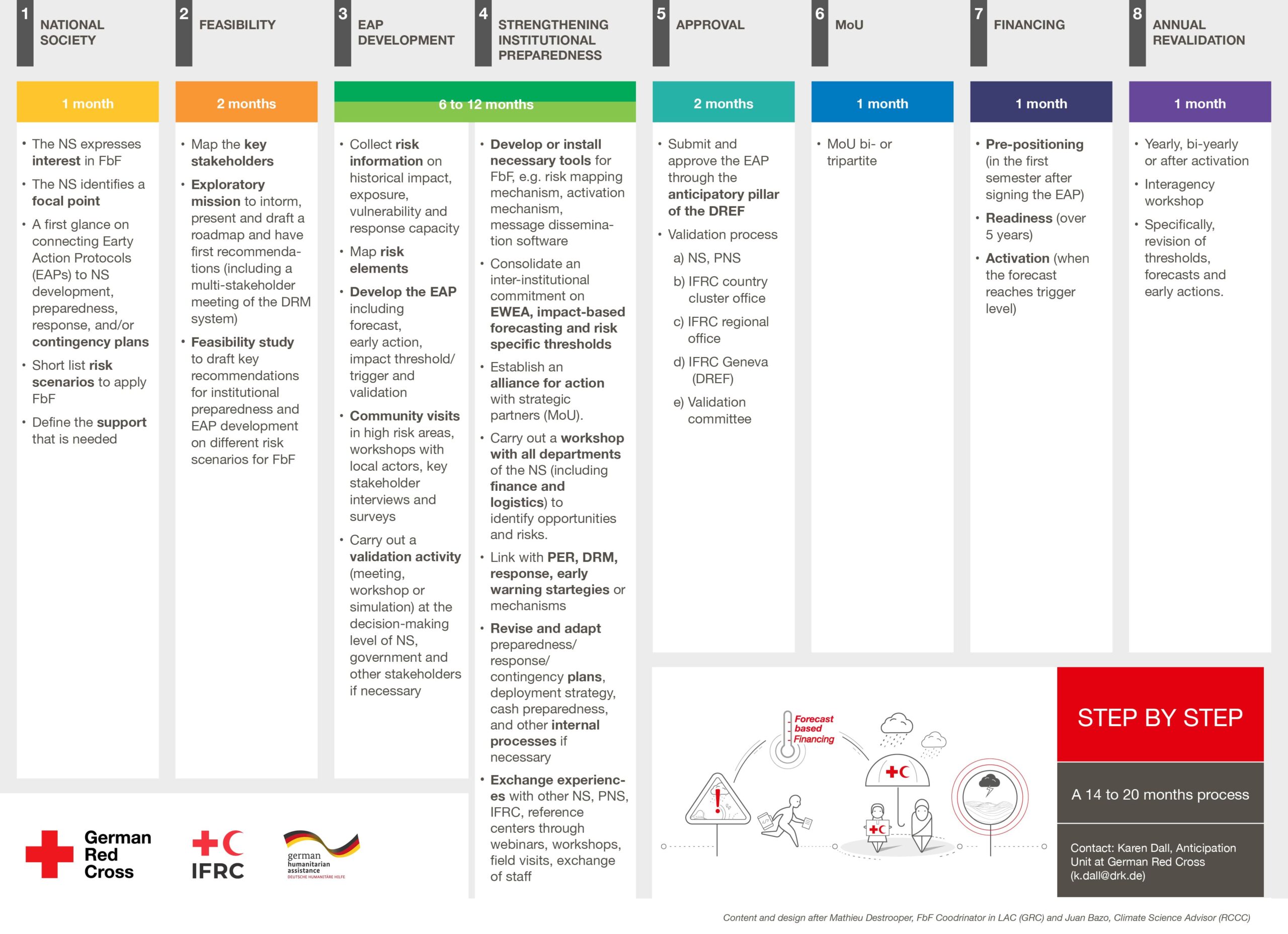
Now that your National Society has decided to start an Anticipatory action program, you should decide whether you will first conduct a scoping study. A study can be a good starting point for building an Anticipatory action system, but it also requires significant investment of time and resources. If you decide not to do a scoping study, you can proceed with chapter 2 Engage your stakeholders and 3 Set up an anticipatory action programme.
What is the value of a scoping study?
A scoping study should provide your National Society a roadmap for anticipatory action. It entails the collection and analysis of information upon which recommendations for the set-up of a anticipatory action system in general and (simplified) EAPs in particular can be made. The roadmap and recommendations should include the following aspects:
Based on an analysis of community priorities, past impacts, available forecasts, the National Society’s operational capacity, mandate and priorities, the scoping study should rank potential hazards, outlining why some hazards are preferred over others.
- Data availability and gaps
The study should give a broad overview of available risk data (e.g. past impact, vulnerability, capacity and exposure data) for the country and recommend which data gaps to fill or where to look for further data.
The study should recommend whether to start with a simplified or a full EAP or, if this emerged from the initial reflections, a different pathway might even be the most suitable option in that context (see chapter 2). In some cases, it might already be clear that skill analyses (assessments of the quality of forecasts) are not available for the full EAP. Hence, for the priority hazards, recommendations regarding the s/EAP should be included.
- Operational and institutional capacity building needs
This section should pinpoint challenges with regards to operational and institutional capacity and outline plans to build those capacities. For example, would current logistics and finance systems allow implementation of early actions to be adopted in the lead time of the selected hazard? How experienced is the National Society in data collection, protection, gender and inclusion (PGI), community engagement and accountability (CEA), MEAL processes or managing funds from the DREF? This analysis could be based on assessments such as the Preparedness for Effective Response (PER; please find documentation of linkages between PER and anticipatory action below in the toolbox). Moreover, recommendations should be made on how to institutionalize anticipatory action within strategies and plans of the National Society to ensure sustainability.
- Strategic collaborations with stakeholders
This section should include a stakeholder analysis and recommend stakeholders to be strategically engaged in the anticipatory action process. Be sure to consider stakeholders with subject matter expertise, such as agriculture, social protection, education, migration, health and many others. The analysis should include a small policy environment analysis and point out mandates, existing MoUs and partnerships, and potential interests in collaboration.
Depending on the depth of the analysis, the scoping study can brainstorm potential early actions based on the analysis of National Society experiences or conversations with communities and other stakeholders. Showcasing potential early actions and how these could reduce hazard impacts helps to make the case for anticipatory action when sharing the results of the study.
A scoping study is not a prerequisite for starting an anticipatory action process. If you see little added value in collecting the information outlined above (e.g. because you have a good overview over those aspects already), you can skip conducting a scoping study. However, aside from the data provided by such an assessment, there are co-benefits of conducting a study:
- Establishing contact with stakeholders/relationship building: A scoping study offers the possibility to begin engaging with other stakeholders on the topic of anticipatory action especially when the focal point is present in all the interviews.
- Capacity building: The focal point and other staff of the National Society can use the study as a learning opportunity by technically and logistically supporting the data collection, reviewing report drafts.
- Reference document: The study can serve as a reference document, e.g. needs assessment, to design a project proposal or to generate buy-in within the National Society or other stakeholders. To ensure this, it is crucial that the study is validated and endorsed by the leadership and other stakeholders like government agencies.