Introduction: What is anticipatory action?

Summary

This introduction gives you

  • A definition of what anticipatory action is
  • Some guidance on how this Manual works and who should read it

Please feel free to reach out to us any time for support! You can find our contact details under contact and contribute.

Anticipatory humanitarian action in the RCRC movement

Anticipatory action is increasingly recognized as a key solution to reducing the impacts of climate change and extreme weather events; anticipatory action helps people and organizations such as National Societies to build resilience to future shocks by better understanding risk and transforming this risk information into action before a disaster strikes.

Building on decades of experience in disaster preparedness, the International Federation of Red Cross and Red Crescent Societies (IFRC) and many National Societies have pioneered the development of anticipatory action approaches since 2014. In 2018, IFRC launched the Anticipatory Pillar of the Disaster Response Emergency Fund, a fund to provide reliable and predictable financing for National Societies to implement anticipatory action.

Even more, anticipatory action within the Red Cross and Red Crescent Movement is now sustainably anchored and committed to: in 2022, the Council of delegates resolution with the title Strengthening anticipatory action in the Movement: Our way forward was adopted, and in 2024, 196 member states adopted a resolution on scaling up anticipatory action at the 34th International Conference of the Red Cross and Red Crescent. Until 2025, the IFRC Operational Framework for Anticipatory Action 2021-2025 aimed at operationalising the scale-up ambition of the Council of delegates resolution into strategic priorities, measurable indicators and the means to achieve the targets.

Please find related documents in the toolbox.

Why anticipatory action?

According to the World Disaster Report (WDR 2020), in the past ten years, 83% of all disasters triggered by natural hazards were caused by extreme weather and climate-related events, such as floods, storms and heatwaves. At the same time, forecasts and early warning for those events are improving, providing information about where and with what magnitude a hazard will strike. Through anticipatory action plans, early warning information is linked to proactive action, allowing timely implementation of actions before a disaster strikes. While anticipatory action originates from addressing weather-related events, the concept is gradually being expanded to non-weather hazards, such as disease outbreaks and the impacts of population movement.

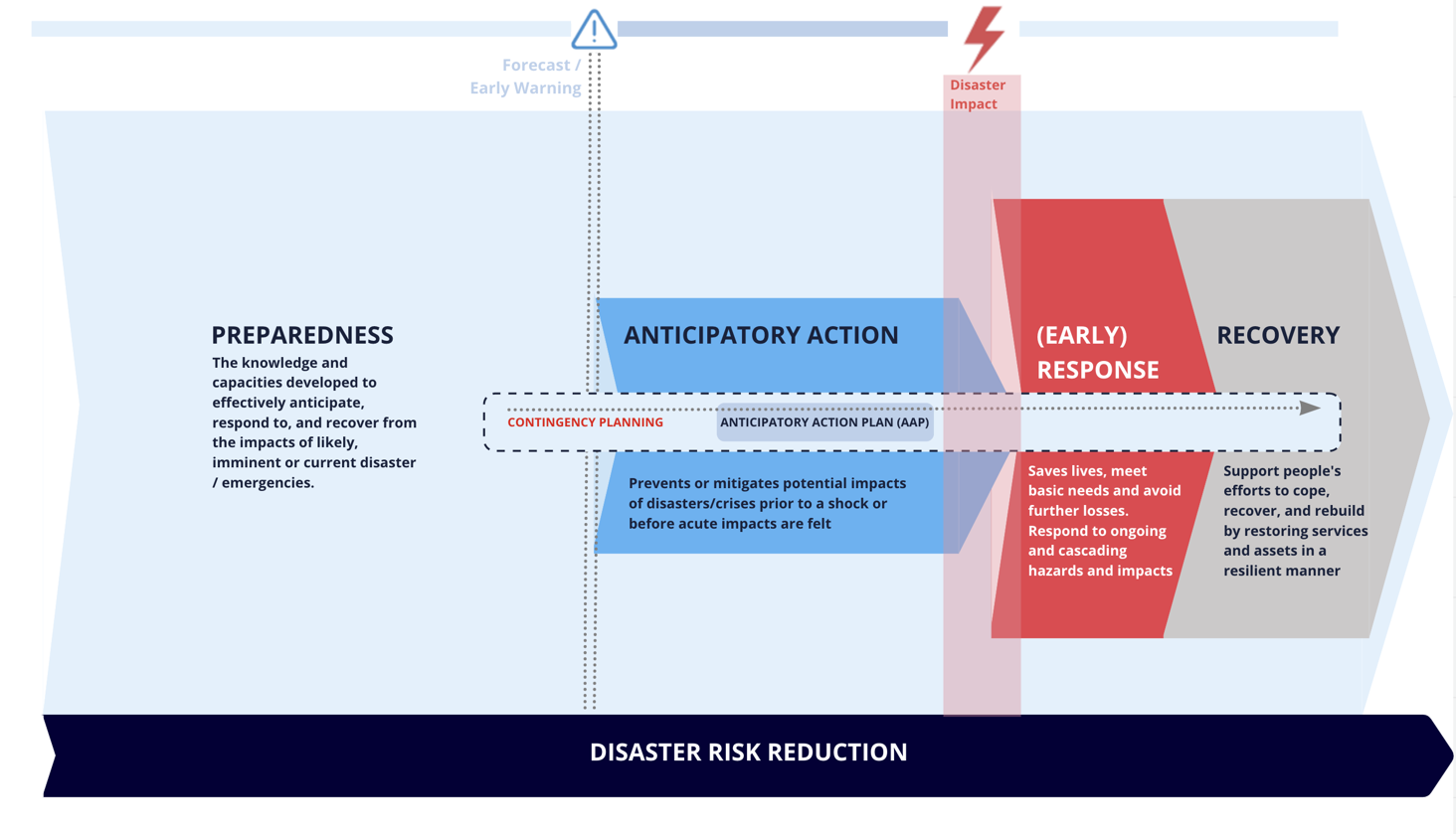
It is important to note that anticipatory action is not a substitute for longer-term investment in risk reduction. Anticipatory action aims at strengthening the capacity to manage risks and at reducing residual risk not addressed through broader disaster risk reduction and longer-term preparedness efforts.

What is anticipatory action?

Anticipatory action is defined as acting ahead of predicted hazards (both weather and non-weather) to prevent or reduce acute humanitarian impacts before they fully unfold. Anticipatory action serves as an umbrella for different terms such as Forecast based-Financing, Forecast-based Action or Early Warning Early Action.

The Grand Bargain Caucus on Scaling Up Anticipatory Action and its formal definition

The Grand Bargain Caucus on Scaling Up Anticipatory Action was a time-bound initiative under the Grand Bargain framework that brought together key humanitarian stakeholders – including donor governments, UN agencies, the Red Cross Red Crescent Movement, NGOs, and technical partners – to advance a shared understanding and scale-up of anticipatory action. The Caucus concluded its work in late 2024, producing a set of common principles and recommendations to guide the wider humanitarian system.

One of its key contributions is a widely endorsed definition of anticipatory action as “acting ahead of a predicted hazardous event to prevent or reduce impacts on lives and livelihoods and humanitarian needs before they fully unfold. This works best when activities, as well as triggers or decision-making rules, are pre-agreed, and decisions are made to guarantee the fast release of pre-arranged funding.”

This definition is now commonly used across the humanitarian sector as a reference point for designing and implementing anticipatory action.

What are the common characteristics of anticipatory action?

Even though anticipatory action can be implemented differently across organizations and with different approaches, methodologies, and scales, three key parameters are generally agreed upon and reflected in the Grand Bargain Caucus definition:

  1. Protective intent: Anticipatory action aims to prevent or mitigate the humanitarian impact of a forecasted hazard.
  2. Time factor: Anticipatory action is implemented in the window of opportunity after an early warning, forecast or pre-disaster risk assessment is available but before the hazard impacts fully materialize.
  3. Risk-informed triggers: Early actions are triggered based on a forecast and / or collaborative analyses.

See toolbox below for further readings, especially the A short overview of anticipatory action.

When is anticipatory action implemented?

Where is anticipatory action implemented?

To get an overview of anticipatory action initiatives around the world, please visit the Anticipation Hub. The Anticipation Hub is a platform to facilitate knowledge exchange, learning, guidance, and advocacy around anticipatory action both virtually and in-person.

How can anticipatory action be delivered and financed?

Anticipatory action can take different forms depending on the institutional and operational context. Within the Red Cross Red Crescent Movement, four main pathways can be distinguished :

  • Early Action Protocols are formalized anticipatory action frameworks that define risk analysis, pre-agreed triggers, early actions and financing in advance. Through a full or simplified EAP, National Societies can access pre-arranged funding via the anticipatory pillar of the IFRC’s Disaster Response Emergency Fund.
  • The Imminent DREF is a flexible and lower-threshold mechanism that allows National Societies to request a fixed amount of DREF funding based on forecasts or predictions of an imminent hazard, even in the absence of a formalized EAP. This pathway can also serve as an entry point or testing ground for anticipatory action.
  • Anticipatory action can be embedded within community-based disaster risk reduction processes, building, for example, on enhanced Vulnerability and Capacity Assessments (eVCA), enabling communities to define and trigger tailored early actions based on local or national warning systems.
  • In their auxiliary role, National Societies may support national or subnational authorities in mainstreaming the concepts and mechanisms of anticipatory action within existing disaster management systems, for example by developing and implementing anticipatory action frameworks at national or subnational levels.

The next chapter provides a detailed overview of these approaches and helps National Societies reflect on suitable entry points.

How this Manual works

The Anticipatory Action Manual is a step-by-step guide for National Societies and partners to implement anticipatory action. It was developed for National Societies, government authorities who are engaged in disaster risk management, hydro-meteorological agencies, humanitarians, academics and the communities themselves to prepare for enhanced Early Warning Early Action (EWEA).

There are different ways for National Societies to approach anticipatory action. Within the Red Cross Red Crescent Movement, these include the development of Early Action Protocols, the use of imminent DREFs, embedding anticipatory action within community-based disaster risk reduction, and leveraging the National Society’s auxiliary role to support governments at national and local levels.

Currently, the most prominent is the development of full and simplified Early Action Protocols (EAPs) which allow guaranteed access to funds from the Anticipatory Pillar of the DREF. However, as outlined in the next chapter, there are other ways of doing anticipatory action and the aim of this Manual is to guide National Societies and their partners through the process. Please have the following in mind when using this Manual:

  • The focus of this Manual is on the development of EAPs. However, many steps are also relevant when you choose another approach to anticipatory action. Hence, the first chapter gives you an overview of the different entry points, the main body of this manual consists of the 13 chapters that guide you step-by-step through the development of an s/EAP while flagging considerations for other approaches. The final chapters contain guidance and considerations for some of these specific approaches as well as reflections on non-weather-related hazards.
  • This Manual is not linear. Though it is organized in chapters and steps, activities will run in parallel, and you may need to revisit certain chapters at different points in the process.
  • There is no standard on how long each individual step takes. This will depend on the context, the National Society and the partners.
  • The Manual addresses you as a reader, but “you” may be a delegate, a project coordinator, a disaster risk management officer or an anticipatory action project team.
  • The Manual is based on experience with weather-related hazards (e.g. floods, tropical storms and heatwaves). However, the methodology is also applicable to non-weather-related hazards, such as epidemics and locust plagues as well as the impacts of population movement (see the final chapter).