Specific Guidance on the Imminent DREF for anticipatory action

Summary

This chapter provides more specific guidance on the imminent DREF as a flexible funding modality for anticipatory action when no pre-approved protocol is in place. It explains when and why to use this mechanism, particularly in sudden-onset emergencies where credible forecasts or early warning indicate an imminent hazard and there is still a short window to act. The chapter outlines key features and requirements, including eligibility criteria, and clarifies how the imminent DREF relates to other anticipatory action approaches, such as (simplified) Early Action Protocols. Finally, the chapter provides practical guidance on how to request, design, and implement an imminent DREF operation, including timelines, budget limits, and operational parameters.

Introduction

The imminent DREF is a funding modality specifically designed for situations where a National Society does not have a pre-approved protocol (s/EAP) but has the opportunity to implement early action in advance of a hazard.

This modality is intended exclusively for sudden-onset disasters where the risk of disaster is clear and imminent. It enables National Societies to implement critical early action and early response actions when:

  • A disaster has not yet occurred, but is highly likely to happen in the near future based on reliable forecasts or early warnings; or
  • A disaster has begun to unfold, but has not yet reached its peak impact, and there remains a short lead time to mitigate the worst effects.

Imminent DREF at a glance

  • Trigger: When the event is on the horizon
  • Requested: max 1 month and min 3 days before the anticipated impact, or peak of the impact
  • Budget: CHF 75,000 for NS, potential to include Rapid Response Deployment (Surge personnel)
  • Allocation: min 75% for early action and max 25% for early response
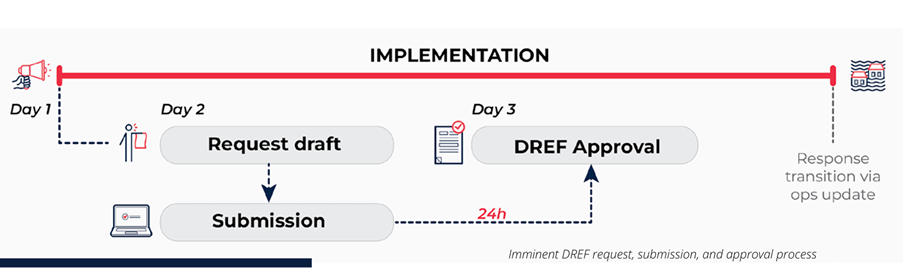
  • Submission: Via GO Platform, decision within 24 hours
  • Operational Timeframe: 45 days (from approval)
  • Scale up: Yes, with an allocation from response DREF

Imminent DREF should not be a replacement for longer-term anticipatory planning. Rather, it serves as a critical stopgap in situations where the National Society has had no time or resources to formalize a pre-approved protocol. It is also an entry point for a National Society that has not done early action before or is still in the process of developing an s/EAPs or has an EAP in place which covers a higher scale of disaster.

What is an Imminent DREF and when should you request it?

Purpose: an imminent DREF enables rapid access to anticipatory funds for immediate early action in advance of a disaster as well as early response to a disaster with short lead time (e.g., within days or weeks).

Trigger mechanism: no pre-agreed trigger; decision is driven by high-confidence forecasts or expert judgement of an imminent event (e.g. a government or national/regional weather agency issues a severe weather alert for a specific area with high certainty)

Connection with s/EAP: an Imminent DREF cannot be requested if the National Society has a simplified Early Action Protocol (sEAP), whether active or already triggered for this hazard, for the same hazard and covering the same geographical area. It also may not be used to scale up or supplement early actions already triggered under an s/ EAP. However, an Imminent DREF can be requested if the National Society has an active EAP for the same hazard with a higher threshold, and a new, reliable alert indicates a hazard at a lower scale would have humanitarian impact, i.e. when the EAP trigger has not been reached but early action is still warranted.

How can you request an imminent DREF and what does it cover?

Requesting an imminent DREF is done by completing a short and simple request template, submitted via the GO Platform, with a quick review and approval process. National Societies require strong and decisive decision-making processes to ensure timely implementation. An imminent DREF can be requested earliest one month and latest three days before the anticipated impact, or peak of the impact.

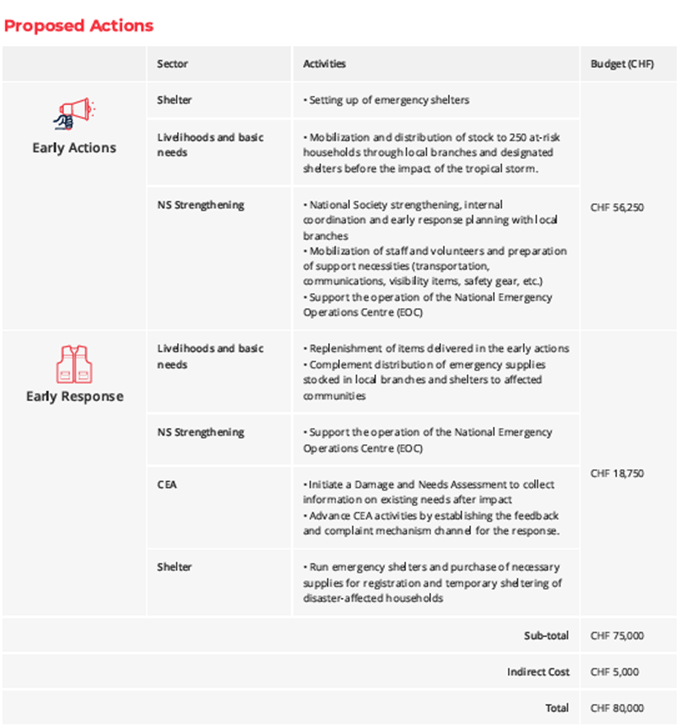
The volume of an imminent DREF is up to CHF 75,000 for National Societies, plus the potential to include Rapid Response Deployment (Surge Personnel). The plan and budget of an imminent DREF must be split into two distinct components:

Early Action: These are activities that aim to prevent or mitigate the expected impact of a hazard before it occurs or before the peak of the impact occurs. They are time-critical and must be implemented quickly, typically within days of receiving a reliable alert. Examples of early action depend upon the hazard, but may include:

  • Dissemination of early warning messages.
  • Distribution of protective materials (e.g. masks, tarpaulins, plastic bags).
  • Distribution of Cash and/or Voucher Assistance.
  • Clearing storm drains, sandbagging, digging ditches or constructing dikes.
  • Supported evacuation of at-risk communities (and their livestock and livelihoods assets).
  • Setting up temporary safe spaces or evacuation shelters.

At least 75% of the total budget must be allocated for early action activities.

Early Response These activities are permitted only if the disaster unfolds within the operational timeframe of the imminent DREF (45 days from the approval day), and they must be implemented in the first hours and days after the impact. These activities are strictly limited to life-saving interventions. Examples of early response activities include:

  • Emergency search and rescue.
  • First aid and casualty evacuation.
  • Assisted evacuation to hospitals or safe areas.
  • Rapid needs assessments

No more than 25% of the total budget may be used for early response activities.

Note, any stock needed must be procured and distributed within the 45 day operational timeframe. Stock cannot be prepositioned. If the National Society has stock available, this can be used and then replenished, as long as the replenishment can be completed within the 45 day operational timeframe. Like any DREF operation, unspent funds are returned to the DREF at the end of the operation.

A testimonial on the Imminent DREF from practice

“My National Society received an alert from the Met Service of imminent floods, which will affect the north of the country. My National Society has been working on developing a sEAP for floods, but it has not been finalized yet. We talked to our Secretary General and quickly decided to request an imminent DREF and test some of the early action activities we planned in the sEAP.

We drafted a simple imminent DREF request and budget. We couldn’t test all the sEAP early actions, since we were missing some stock and capacity, so we prioritized the dissemination of early warning messages using PAPE messaging and assisted evacuation of at risk communities, and distribute multipurpose cash based to people registered in our National Society’s social welfare programme.

Luckily the floods didn’t have significant impact, so we didn’t do the early response activities. We learned some good lessons during the implementation of the imminent DREF, which have been incorporated into the sEAP for floods.

Our experience with the Imminent DREF got us thinking about what sort of response operation we would plan to complement the early action activities in the sEAP, should the floods materialize.”

National Society Operations Manager, Red Cross Red Crescent

Scaling up: A National Society with an imminent DREF allocation can scale up with an additional allocation from the DREF for a disaster response, should the hazard materialise. The National Society transitions via an operations update. A final report is required after the end of the operational timeframe.

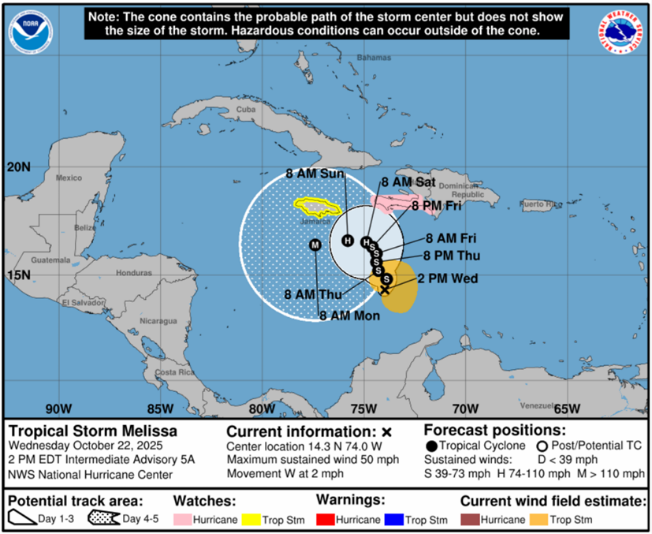
Experience from Jamaica in advance of Hurricane Melissa

Starting on 21 October, a tropical storm started forming in the Caribbean. Over the coming days it continued to intensify.

Jamaican Red Cross submitted an imminent DREF request on 23 October 2025, within 12 hours the approval was granted.  The transfer of funds was made on the same day, 23 October, from the IFRC Americas Regional Office to the Jamaican Red Cross.

Over the following days, Melissa became better organized, and from October 25 to 27, rapidly intensified into a Category 5 hurricane before making landfall near New Hope, Jamaica, just below peak intensity, on October 28.

The forecasted track of Hurricane Melissa as of 22 October

The imminent DREF operation was complemented with an Emergency Appeal of CHF 19 million, including a loan from the IFRC-DREF of CHF 1 million, to kick start response activities until public donations are received by the Appeal.

For more information on the IFRC’s Imminent DREF, please review chapters: 3.2 “decision to apply for funds”, or for more in depth information, “3.5 Imminent DREF”, in the latest version of the IFRC-DREF Guidelines (2026).