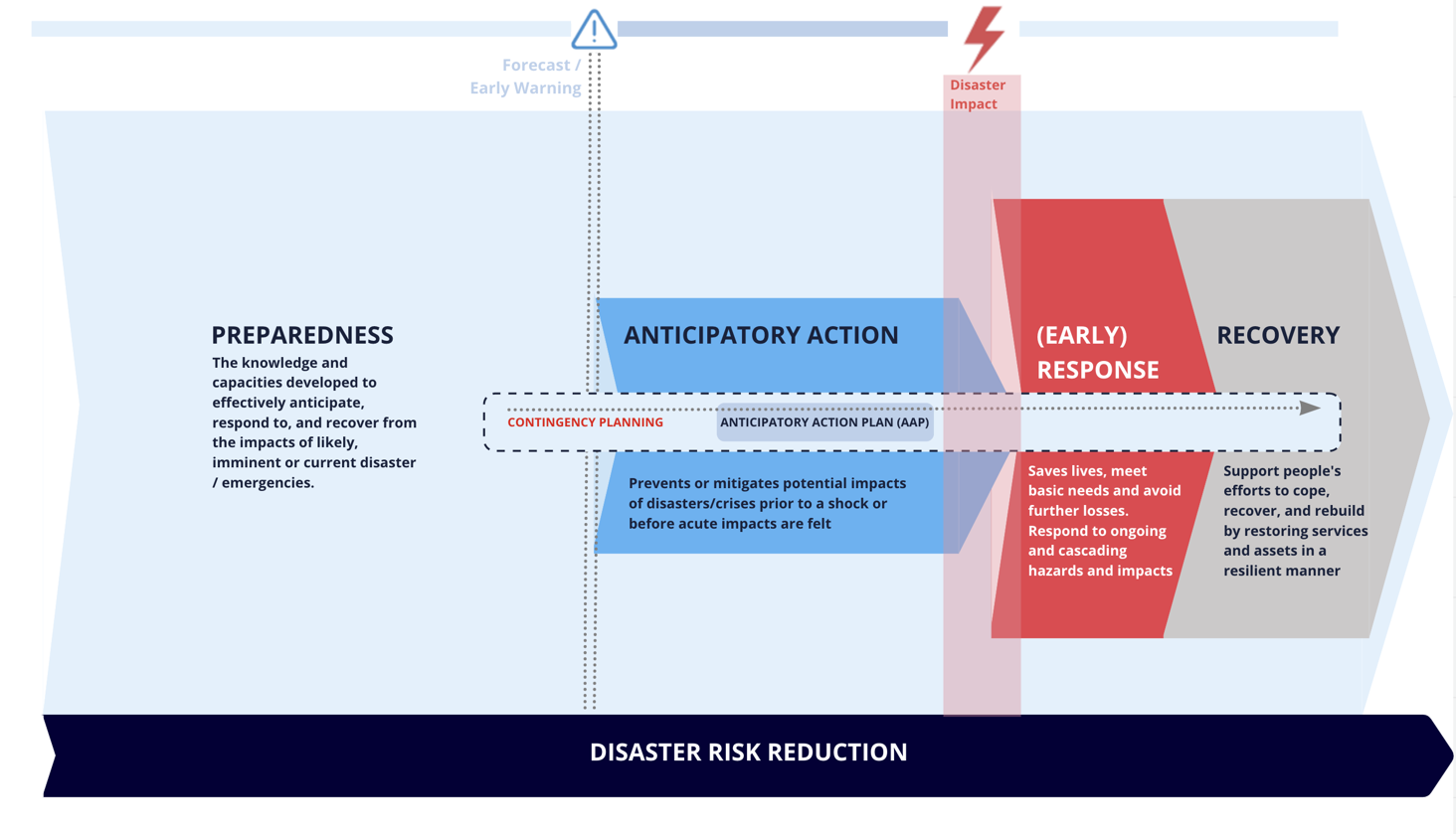
Anticipatory action is increasingly recognized as a key solution to reducing the impacts of climate change and extreme weather events; anticipatory action helps people and organizations such as National Societies to build resilience to future shocks by better understanding risk and transforming this risk information into action before a disaster strikes.
Building on decades of experience in disaster preparedness, the International Federation of Red Cross and Red Crescent Societies (IFRC) and many National Societies have pioneered the development of anticipatory action approaches since 2014. In 2018, IFRC launched the Anticipatory Pillar of the Disaster Response Emergency Fund, a fund to provide reliable and predictable financing for National Societies to implement anticipatory action.
Even more, anticipatory action within the Red Cross and Red Crescent Movement is now sustainably anchored and committed to: in 2022, the Council of delegates resolution with the title Strengthening anticipatory action in the Movement: Our way forward was adopted, and in 2024, 196 member states adopted a resolution on scaling up anticipatory action at the 34th International Conference of the Red Cross and Red Crescent. Until 2025, the IFRC Operational Framework for Anticipatory Action 2021-2025 aimed at operationalising the scale-up ambition of the Council of delegates resolution into strategic priorities, measurable indicators and the means to achieve the targets.
Please find related documents in the toolbox.
Why anticipatory action?
According to the World Disaster Report (WDR 2020), in the past ten years, 83% of all disasters triggered by natural hazards were caused by extreme weather and climate-related events, such as floods, storms and heatwaves. At the same time, forecasts and early warning for those events are improving, providing information about where and with what magnitude a hazard will strike. Through anticipatory action plans, early warning information is linked to proactive action, allowing timely implementation of actions before a disaster strikes. While anticipatory action originates from addressing weather-related events, the concept is gradually being expanded to non-weather hazards, such as disease outbreaks and the impacts of population movement.
It is important to note that anticipatory action is not a substitute for longer-term investment in risk reduction. Anticipatory action aims at strengthening the capacity to manage risks and at reducing residual risk not addressed through broader disaster risk reduction and longer-term preparedness efforts.
What is anticipatory action?
Anticipatory action is defined as acting ahead of predicted hazards (both weather and non-weather) to prevent or reduce acute humanitarian impacts before they fully unfold. Anticipatory action serves as an umbrella for different terms such as Forecast based-Financing, Forecast-based Action or Early Warning Early Action.